
And moments designed to dominate headlines the following morning. Yet amid the lights, the applause, and the carefully rehearsed spectacles.
One moment cut through the noise with startling force. It did not arrive with fireworks or choreography. It arrived with silence. By the time the night ended, many in attendance—and millions watching at home—would describe the same feeling: t
hat something deeply human had unfolded onstage.
Something raw, vulnerable, and impossible to forget. At the center of it all was Jelly Roll.
A Performance That Began Like a Celebration
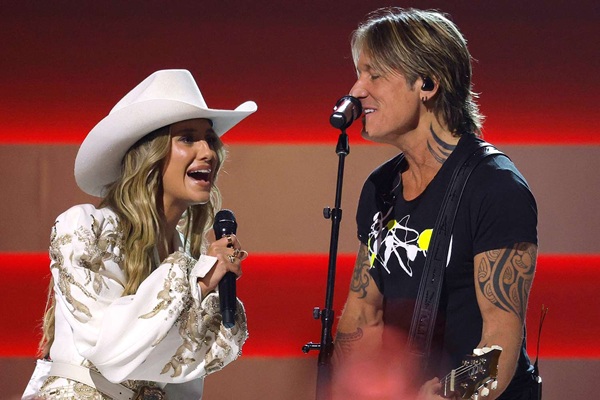
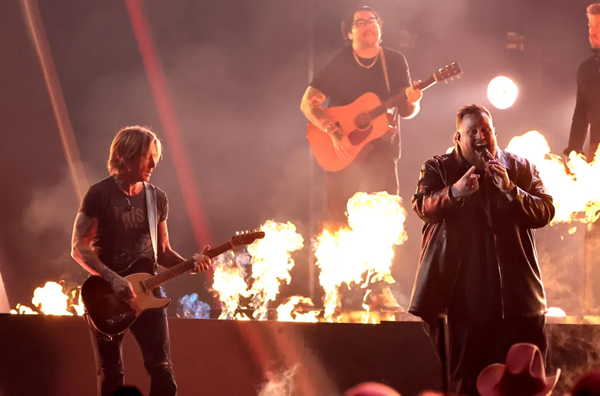
The moment began as one of the evening’s most anticipated performances: a duet between Jelly Roll and country icon Keith Urban.
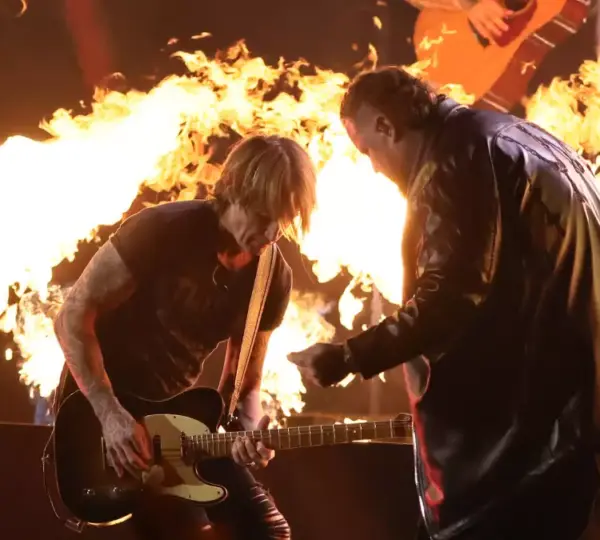
The pairing alone was enough to excite fans—two artists from different backgrounds, united by storytelling, grit, and emotional honesty.
As the opening notes rang out inside Nashville’s Bridgestone Arena, the energy was electric. Red and gold lights swept across the crowd as the band locked into a powerful groove.
Jelly Roll’s signature gravel-edged vocals blended seamlessly with Urban’s precise guitar work, creating a sound that felt both explosive and intimate.
They launched into “Liar,” a standout track from Jelly Roll’s album Beautifully Broken, a record that had already resonated deeply with listeners for its unfiltered look at personal struggle, accountability, and recovery.
At first, everything followed expectation. The crowd roared.
Phones lifted into the air. Two stars commanded the stage.
Then, unexpectedly, the atmosphere shifted.
When the Music Fell Away
Midway through the song, the instrumentation softened. What initially felt like a dramatic musical pause quickly became something else entirely.
The band stopped. The lights dimmed. The noise of the arena dissolved into near silence.
Jelly Roll stepped forward.
According to those in the arena, time seemed to slow. He dropped to one knee at center stage—not as part of choreography, but with the weight of someone carrying more than lyrics.
His eyes moved toward the front row, where his wife, Bunnie XO, sat watching, visibly emotional.
Not as a performer. Not as a celebrity. But as a man choosing honesty in the most public way possible.
“I was wrong,” he said, his voice audibly breaking. “And this is how I tell the truth… in front of the whole world.”
There was no background music. No dramatic lighting cue. No script.
Just a confession carried through an arena holding thousands of people who suddenly seemed afraid to breathe.
An Arena Held in Silence
It is rare for silence to dominate a venue built for noise. Yet eyewitnesses described a stillness so complete that every word carried unmistakable weight.
Keith Urban, visibly moved, stepped closer. He placed a hand on Jelly Roll’s shoulder—not as a collaborator, but as a quiet show of solidarity.
It was a moment that required no explanation, no speech, and no spotlight.
The crowd did not interrupt. There were no cheers. No applause. Only presence.
Many later described the moment not as a performance, but as a reckoning unfolding in real time.
A Song Rooted in Truth
“Liar” has never been an easy song. From its release, it stood apart as a brutally honest examination of relapse, self-deception, and the long road back to accountability.
The lyrics do not offer clean resolutions or heroic endings. Instead, they sit in discomfort—acknowledging failure while refusing to surrender to it.
For Jelly Roll, whose career has often intersected with public conversations about recovery and personal growth, the song represents more than storytelling. It reflects lived experience.
That night, the CMA stage became something else entirely.
Not a platform for promotion. Not a space for perfection. But a confessional.
The Internet Responds in Real Time
Within minutes, social media erupted.
Clips of the moment spread rapidly across platforms, accompanied by reactions that felt more like personal testimonies than typical celebrity commentary.
Fans wrote that they had never seen anything like it on an awards show stage.
“That wasn’t a performance—that was a prayer.” “We don’t need perfection. We need honesty like this.” “That took courage.”
The hashtag #JellyRollCMA surged across X and other platforms, trending worldwide as viewers attempted to put words to what they had just witnessed.
Meanwhile, backstage, Bunnie XO shared a single black-and-white image: Jelly Roll reaching toward her, hand extended, vulnerability unmistakable. The caption contained only a heart emoji.
Nothing else needed to be said.
A Career Built on Giving Voice to the Broken
Jelly Roll’s rise has never followed a traditional path. Long before awards shows and chart-topping albums, his music found its audience among people who felt unseen—those navigating addiction, regret, grief, and second chances.
His songs rarely offer easy answers. Instead, they sit with pain, naming it without flinching.
That authenticity has become his defining trait, and it is precisely why moments like the one at the CMAs resonated so deeply.

For many fans, Jelly Roll does not sing at them. He sings with them.
The Risk of Being Seen
Award shows are carefully curated environments. Every second is planned. Every camera angle is deliberate. Vulnerability is often rehearsed, measured, and contained.
What unfolded that night broke those rules.
There was risk in stopping the music. Risk in speaking unscripted. Risk in choosing honesty over polish.
But that risk is exactly what made the moment matter.
By stepping into discomfort publicly, Jelly Roll reminded audiences of something easily forgotten in celebrity culture: healing is not linear, and accountability does not always arrive neatly packaged.
Sometimes, it arrives shaking.
Keith Urban’s Quiet Role
Keith Urban’s presence mattered. Rather than redirecting attention or attempting to steer the moment back into performance, he allowed it to exist as it was.
His simple gesture—a hand on a shoulder—communicated support without spectacle.
It was not about saving the show. It was about standing beside someone in a moment of truth.
That restraint spoke volumes.
Beyond Optics and Applause
In the days following the CMAs, conversations continued. Analysts debated whether such vulnerability belonged on an awards stage. Fans pushed back, arguing that authenticity is exactly what music is meant to deliver.
What remained clear was this: the moment could not be reduced to publicity or performance strategy. There was no obvious benefit to exposing oneself so completely in front of millions.
And that is why it mattered. This was not about redemption as branding. It was about accountability as practice.
A Reminder of What Courage Looks Like
Courage is often framed as strength without cracks. But what unfolded at the 2025 CMA Awards offered a different definition.
Courage looked like stopping the music. Like admitting fault without defense.
Like telling the truth when silence would have been easier.
Under the brightest lights of his career, Jelly Roll chose honesty over comfort.
And in doing so, he created a moment that transcended awards, genres, and expectations.
A Night That Will Be Remembered
Years from now, the 2025 CMA Awards will be remembered for many things—winning performances, standout collaborations, and chart milestones.
But for many, one image will endure above all others:
A man on one knee. A crowd holding its breath. And the realization that sometimes, the most powerful moments in music happen when the song stops.
Jelly Roll did not just perform redemption that night.